Eltham Hill secondary school: using Wellbeing Measurement for Schools pupils’ surveys as a baseline approach
Anna Freud’s Head of Training, Vicky Saward recently met Isobel Tooher who is a Head of Year at Eltham Hill Secondary School, and colleagues, last academic year, as part of their work towards embedding a whole-school approach to mental health and wellbeing - one of the core aims of the Mental Health in Schools programme (funded by the Mayor of London).
As part of this programme, their Deputy Head, Polly White, carried out a whole-school review using the 5 Steps Framework, which features Wellbeing Measurement for Schools as part of ‘Understanding Need’ (step 3).
Heads of Year from their school, including Isobel, attended training about monitoring and measuring student wellbeing. Isobel has since advised that she has been using some of CORC’s Wellbeing Measurement for Schools pupil surveys, so we took the opportunity to find out how these were being used.
Why were the Wellbeing Measurement for School pupil surveys decided to be used?
Isobel was particularly enthusiastic that the Wellbeing Measurement for Schools Pupil Survey booklets were free to download and therefore cost effective to just print off and be used straight away. She mentioned that there is often a new system that must be used when applying a new process, which can create a learning or user barrier for implementation.
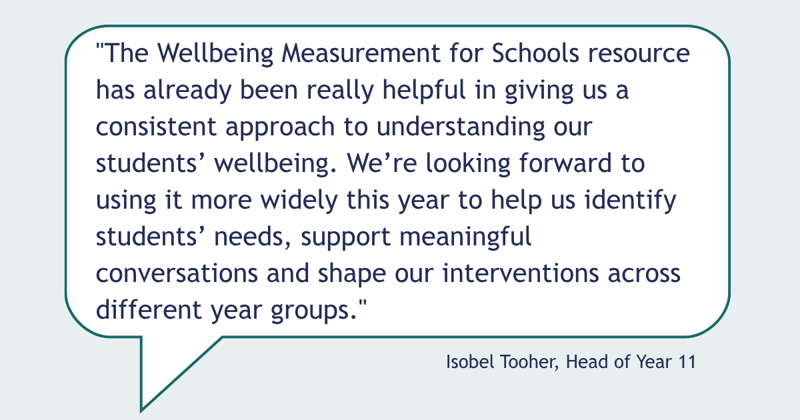
Isobel found the five booklets to be a really helpful guide and advised that they would be using these to adapt how they approach their interventions across the different age groups going forward within their school – factoring in the questions for pupils before and after interventions.
She said that she found the pupil wellbeing surveys to be quite quick for pupils to be able to do; were in a good child friendly language, making them easy to use, “even if the reading age is low, they are easy to understand by all to be able to get the best answers”. Saying that overall, they are very accessible.
At their school, each of Heads of Year had been doing their own thing, so using the Wellbeing Measurement for Schools approach has provided a baseline which all years can now do consistently. Isobel advised that they will be planned into intervention groups from the new school year this September. She highlighted that there are a broad range of topics covered, which will be relevant to the different year groups.
Which surveys are being used, and how they are intended to be used?
Each Head of Year at Eltham Hill School has an academic focus, but they are mindful of pupils’ wellbeing, and anxieties around exams for instance. When teaching staff believe support is required, they will refer individuals on to their Wellbeing or Mental Health Support Team, who will provide support in small groups.
The school draws on a variety of information, including attendance, behaviour, and disadvantage indicators, to identify pupils who may benefit from additional support. Building on this by adopting a more consistent approach across cohorts will help create a fuller picture of pupil needs and strengths, informing ongoing planning and provision.
Isobel fed back that the content within the booklets has been useful so far with enabling how staff can have conversations with pupils, knowing which questions are best to ask. There are some ages or cohorts of pupils that are challenging to get to open up, so using the questions provided have been beneficial.
They have found that when using the questions with young people that require behaviour support, the Emotional Strengths and Skills booklet has shown that what the young person presents, and what they are feeling, doesn’t always match – offering useful insight.
Each of their Heads of Year and the Pastoral team meet each half term, and the content of each booklet is being considered based on the different year group's needs.
The School Life booklet they have sighted as being useful for Year 7, with the transition from primary to secondary school – monitoring pupils’ feedback before providing most relevant support.
For those in Year 11, they are mindful that surveys which provide insight into anxiety around exams will be used to gain pupil feedback before relevant interventions are applied. The Emotional Health survey they have identified provides useful survey questions for this.
Eltham Hill secondary school recognise the implication of wider wellbeing factors on pupils’ academic performance, such as revision skills; the impact of social media; and friendships, for instance. Integrating the Wellbeing Measurement for Schools approach will ensure a whole-school approach.
Isobel believes the consistent approach this offers: to be able to measure information within groups of pupils, will provide the school, and year groups, with baseline data to inform interventions. And that progress can be tracked using the surveys afterward, to further inform.
Overall feedback and next steps
Isobel is looking forward to their staff team using Wellbeing Measurement for Schools as a baseline approach for their interventions this school year and have kindly agreed to provide further feedback later next year to report further on their findings. Using the surveys as question prompts by some year groups since March last year has driven this decision.
Isobel did highlight that perhaps one of the areas not yet covered, when considering the different year groups, is for Year 12’s, as they approach the leaving of school, and what wellbeing questions could be measured around this, to be able to apply useful interventions.