Lessons learned from the London Vanguards evaluation
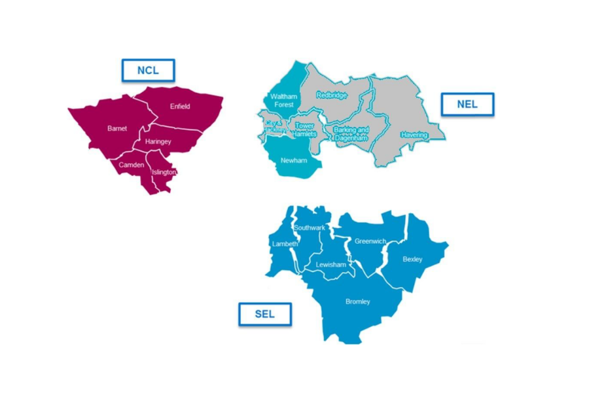
NHS England’s Framework for Integrated Care (Community) is designed to deliver system transformation by providing new structures to offer a ‘scaffold’ to existing local services. The framework helps facilitate organisational change. It also supports the development and enhancement of services that promote safeguarding and prevent re-traumatisation. Overall, it aims to help children and young people thrive. In response to a competitive tender, this is being piloted across London in three ICBs: North Central, North East and South East London. Each of the London Vanguards is taking a collaborative approach between VCSE and statutory organisations, with support embedded in the community.
Our independent three year evaluation of the London Vanguards ran from 2022 to 2025. The evaluation explored what works and what can be learned when supporting children and young people who face social adversities and may be affected by violence.
We analysed data on 1,509 children and young people across 12 London boroughs, and conducted interviews with 88 young people, parents, carers and staff across four boroughs. Most participants were interviewed twice over a 12 month period. The combined findings highlight the importance of sustained, relational, community‑embedded mental health-informed support to improve outcomes for children and young people in complex circumstances. The findings also highlight practical considerations for delivering this at scale in complex, high‑need areas like London.
Uncovering and responding to previously unmet needsTwo standout themes in the evaluation were the focus on supporting children and young people from marginalised groups, and uncovering and responding to previously unmet needs. The London Vanguards reported uncovering neurodevelopmental, speech and language, learning, and mental health needs in the children and young people supported, that had not been formally recognised elsewhere. This illustrates the propensity for children and young people who face structural inequalities such as racism, poverty and health inequalities to otherwise not receive essential support. The evaluation findings suggest that a holistic, personalised approach was essential in meeting the intersecting needs of the children and young people supported. This serves as a reminder that emotional distress and what are traditionally termed ‘risky’ behaviours rarely present in isolation, but rather are positioned in layers of unmet developmental, social, and psychological needs.
Outcomes
From the data available, our evaluation findings show that young people were reported to have improved in a range of areas following support. This included mental health and wellbeing, education and employment, housing, and contact with the youth justice system. The quantitative outcomes were supplemented by the rich qualitative findings. Here, children and young people described becoming the ‘best version’ of themselves through the London Vanguards support, and parents and carers described improved confidence, communication, emotion regulation, and strengthened peer and family relationships. Crucially, these improvements were often sustained for at least a year, attributed to the long‑term, relationship‑centred nature of the support.
Our evaluation findings underscore the role of holistic support. Interventions that extend beyond the individual, that address housing, education, and family relationships are often essential components of meaningful therapeutic change. Reductions in offending behaviour, high-risk behaviour severity and frequency were also reported, which aligns with the key facet of the programme being violence reduction, although many improvements in this area will not be seen due to the longer timeframe in which you can expect to see change in this area.
While we must be mindful of high amounts of missing data when interpretating the findings, the findings align with evidence that violence reduction is most effective when mental health support, relational continuity, and practical life changes occur together, not as isolated interventions.
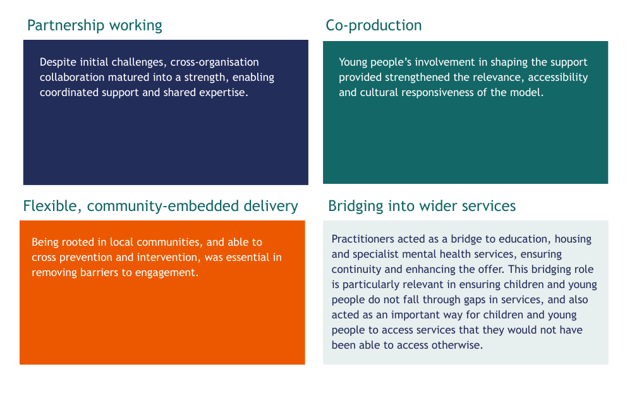
We found that change was enabled by:
Implications
The London Vanguards model as strategically aligned with national policy priorities, including the NHS England 10‑year plan and government missions around prevention and reducing serious violence. The importance of long-term support that is relational in nature mirrors the findings from CORC’s other evaluations of programmes that support similar cohorts of children and young people (e.g., most recently Humber and North Yorkshire children and young people’s trauma informed care programme).
In terms of next steps, staff who took part in the London Vanguards evaluation emphasised the need for long‑term funding and ongoing training, leadership, and partnership investment. Key considerations highlighted by our evaluation are: the potential for expansion, system level challenges, funding and sustainability, and learning opportunities of short term pilots. We hope that the findings and recommendations from our evaluation will help to shape delivery as the pilot goes into the next phase (2025-2028).
The findings from our evaluation offer transferable learning that mental health services can apply to strengthen support for children and young people facing complex social adversities. The uncovering of previously unmet neurodevelopmental, speech and language, learning, and mental health needs, particularly among marginalised groups, demonstrates the importance of proactive, multidisciplinary assessment models that can bridge gaps often created by structural inequalities. Additionally, the success of partnership working, co production with young people, flexible community based delivery, and strong bridging roles into wider services points to approaches that mental health systems across the UK could apply to improve continuity, accessibility, and cultural responsiveness.
Thank you again for everyone who took part in, and supported, our evaluation.
The final evaluation reports can be found here:
London Vanguard headline report
London Vanguard report summary